
Significance
The valuable resources conservation and utilization is the best practice to minimize waste generated from operations as much as possible. The appropriate and efficient waste management can also help lower costs on waste disposals, including reducing impacts on environment and surrounding communities caused by hazardous waste leakages and improper disposal from thermal power plants. In addition to non–hazardous and hazardous waste, there are ash and gypsum created from fuel combustions and air quality treatment processes, which can be utilized and added value by selling them as mixtures of construction materials.
2025 Target
- Hazardous waste directly disposed of ≤ 210 tonnes/year
- Combined heat and power plants ≤ 210 tonnes/year
- Gas-fired power plants = 0 tonne/year
- Non-hazardous waste directly disposed of ≤ 793 tonnes/year
- Combined heat and power plants ≤ 793 tonnes/year
- Gas-fired power plants = 0 tonne/year
- Zero hazardous waste to landfill
- Zero incidents of significant leaks
- Proportion of fly ash reused or recycled equivalent to 100% per year
- Proportion of synthetic gypsum reused or recycled equivalent to 100% per year
Management Approach
BPP determines the targets to eliminate waste and monitors its performance against the annual target in order to ensure that the operation is carried out in accordance with the best practice and legal requirements of each country. BPP’s waste management approach is based on the 3Rs principle, including:
- Reducing waste at its original sources.
- Reuse
- Recycle
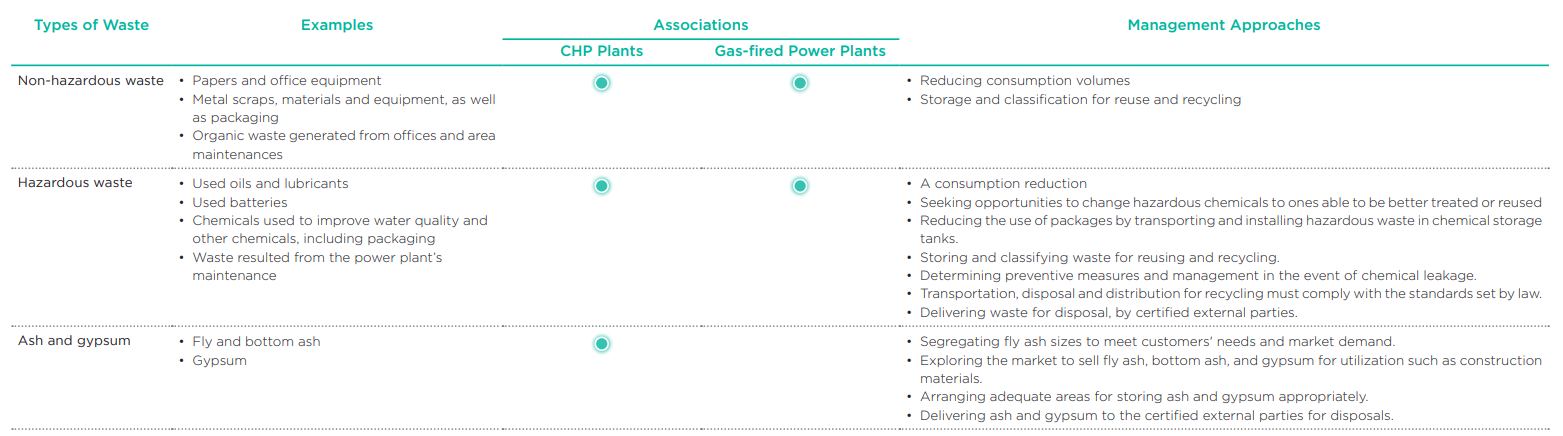
Moreover, BPP promotes the practice guideline for eliminating waste throughout the supply chain. It also classifies waste from its power plants into 3 categories, of which the management approach is concluded as follows:
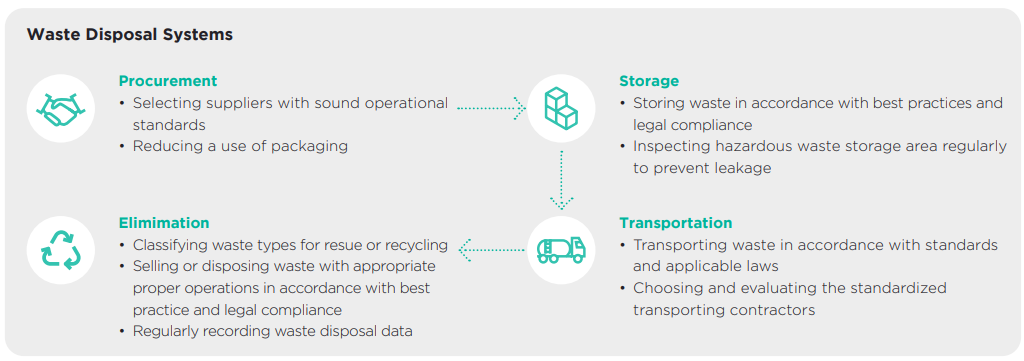
To assess waste management performance, BPP has collected waste data in accordance with the GRI 306 Waste (2020) standard since the year 2021, by compiling the amount of waste generated and delivered for disposal through weighing and recording data prior to either management or disposals. The amount of waste transported for disposal by outside agencies has been recorded from the receipts. Moreover, agencies permitted by the government are selected to transport and dispose waste so as to ensure that the waste management meet standards according to the requirements of each country and have the least impact on the environment.
Meanwhile, ash and synthetic gypsum – by-products produced by the CHP plants, are included as the non-hazardous waste. These by-product sizes are separated in order to create added values and sell to customers in the construction industry.
2025 Performance
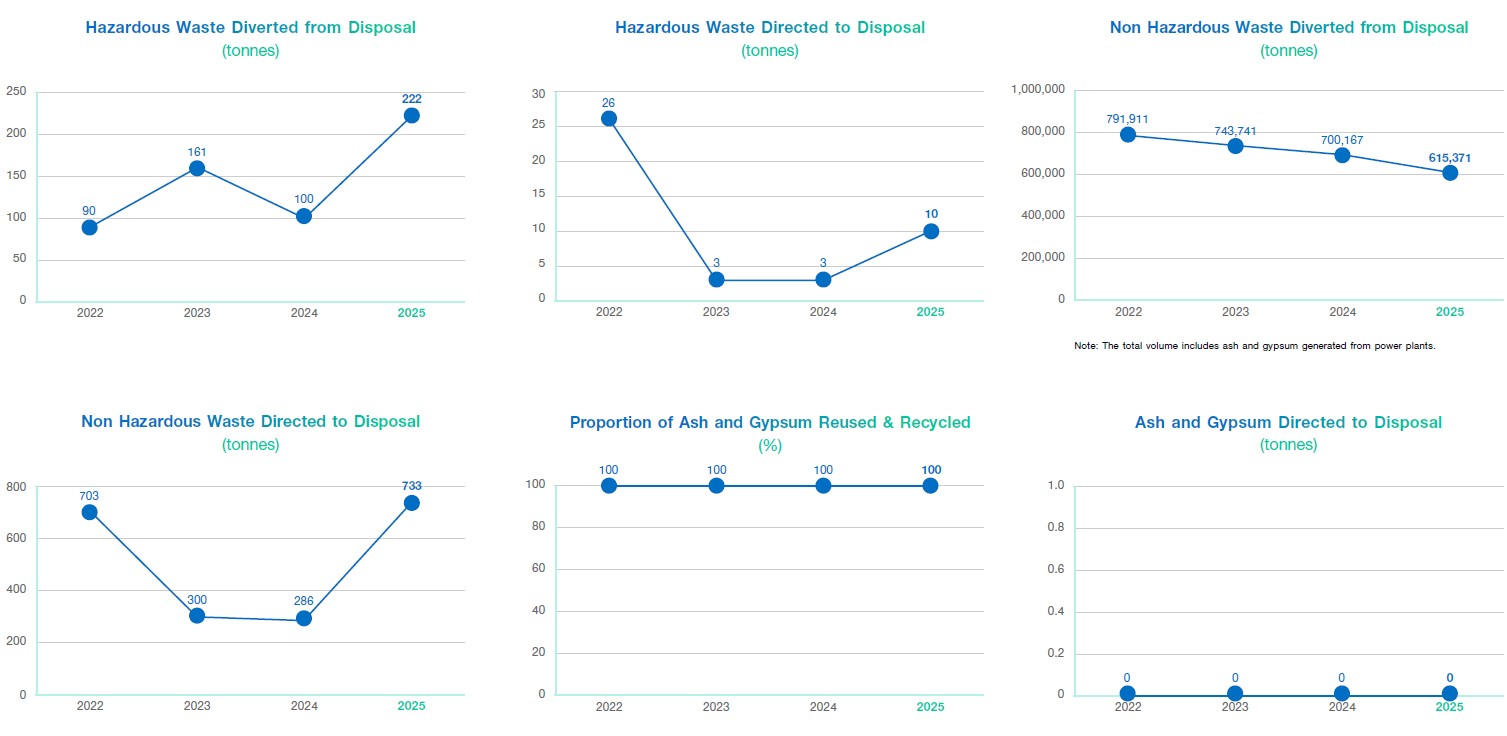
- In 2025, BPP generated a total of 616,332 tonnes of waste, consisting of 231 tonnes of hazardous waste and 616,101 tonnes of non-hazardous waste (including ash and gypsum). All waste was managed by external parties, with no disposal occurring within power plant areas. Of the total, 10 tonnes of hazardous waste and 733 tonnes of non-hazardous waste were directly disposed of, while zero hazardous waste was sent to landfills. In addition, 100% of the 542,807 tonnes of ash and gypsum generated were reused or recycled. No significant oil or chemical spills were reported during the year, achieving the Company’s overall waste management target.
- Combined heat and power plants in China directly disposed of 10 tonnes of hazardous waste and 681 tonnes of non-hazardous waste. However, all ash and gypsum were reused or recycled, successfully meeting the set target. Fly ash was sorted by size before being sold for use in construction materials. This size separation process added value to the fly ash, enabling it to gain higher prices as it meets specific customer requirements.
- Gas-fired power plants in the United States had zero hazardous waste directly disposed of, meeting the set target. However, 52 tonnes of non-hazardous waste were directly disposed of, exceeding the set target. All non-hazardous waste consisted of office waste and was sent to landfill by authorized external agencies.
- The Company has reviewed and established non-hazardous waste management targets for 2026-2030.
Key Activities and Projects
The Utilization of Industrial Waste Compounded with Coal as Fuels (multisource solid waste compound fuels) at Zouping CHP Plant
The multisource solid waste compound fuels of Zouping CHP Plant is one of the innovative thinking processes to reduce the power plant’s production costs. Zouping CHP Plant studied on how to utilize the solid wastes left over from production processes or from industrial plants with maximum benefits. This initiative was done by surveying industrial wastes in the vicinity where wastes still have calorific values and can be used for boiler’s combustions. The survey found that wastes such as used activated carbons, fly ashes and sludges from the wastewater treatment plants, etc., still have calorific values, and can be used for further combustions.
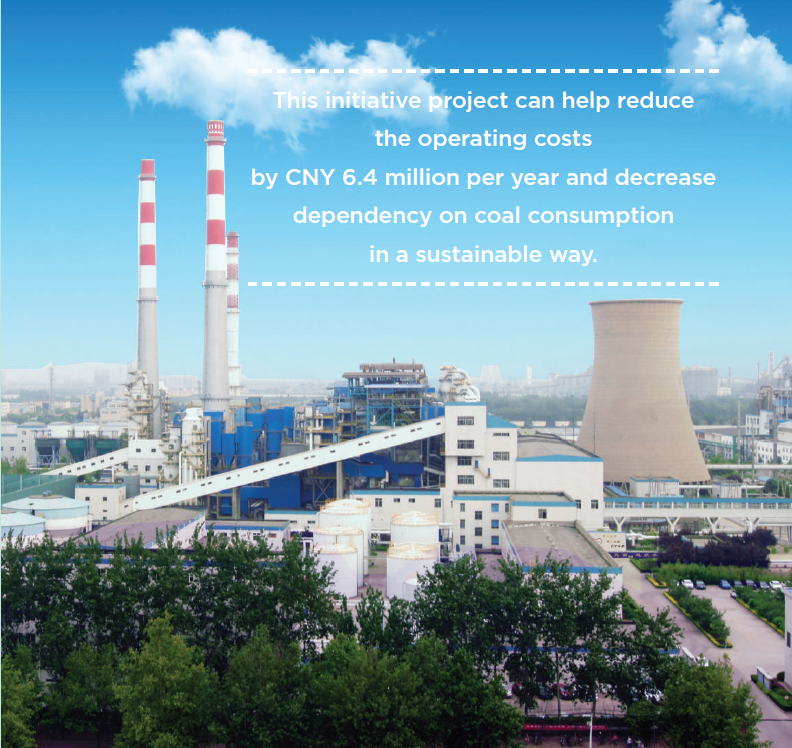
Zouping CHP Plant conducted a study and carried out a test by using activated carbons with a heat value of about 2,300 kcal/kg from the customer’s sugar factory to mix with coal until the blending ratio does not affect its production capacity, while the air quality released from stacks does not exceed the standard ratio of 10-20%. The experiment found that approximately 2,000-4,000 tonnes of activated carbons can subsidize 600-1,260 tonnes of coal. This initiative project can help reduce the operating costs by CNY 6.4 million per year and decrease dependency on coal consumption in a sustainable way. Moreover, it is another way to help lessen the waste problems from customer’s industries, though, the waste-blending has resulted in a slight decrease of boiler efficiency by about 0.66%.
Wenyu Riverside Cleanup Project to create environmental awareness among employees
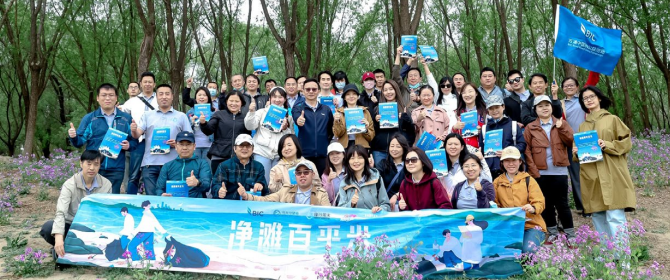
Banpu Investment (China) Ltd. or BIC, BPP’s subsidiary in China, joined hands with the Beijing Environmental Protection Foundation (Beijing Watcher) to organize a beach clean-up activity along the Wenyu River in Beijing City on 19 April, 2024, with more than 40 employee volunteers participating. At the event, the employees were divided into 4 groups to collect trash from the beautiful beach area, such as cigarette butts, bottle caps, used plastic bags, etc., and a 28 KG total weight of garbage was collected.
This activity has not only improved the scenery along the river, but it has also helped employees understand the dangers of waste affecting the environment as well as the importance of better protecting river ecosystems. Moreover, it has created participation from employees and local agencies, demonstrating the employees’ social responsibility in every country in which BPP has operated.
Educating employees on waste management
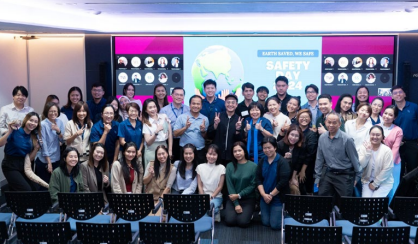
Seeing the importance of employees as a good citizen who can play a key role in conserving resources, Banpu Group invited Mr. Chanat Wuttiwikaikan or Kong Greengreen, a famous content creator to be a guest speaker at the “Safety Day” event, held on 6 November 2024. An inspiring session on how to protect the earth in a fun and easy way through social media was given by Kong Greengreen, with an aim to provide knowledge to Banpu Group’s employees and educate them about facts regarding waste problems in Thailand. This included telling participating employees how to separate different types of waste and the ways to reduce waste, such as using cloth bags instead of plastic bags, reusing or recycling waste for maximum benefits, etc. At the event, activities involved with correct sorting of waste into different types of trash bins were organized, with over 100 employees attending the event.
Using Black Soldier Fly (BSF) larvae to help decompose organic waste
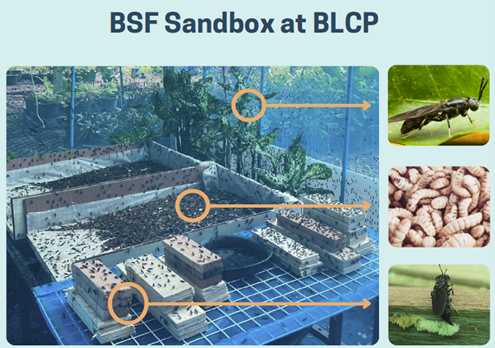
BLCP Power Plant has implemented a project utilizing black soldier fly (BSF) larvae to help solve the organic waste problem in Rayong Province, particularly food waste, which accounts for approximately 60% of the total waste, or about 420 tonnes per day. This project utilizes BSF larvae to efficiently decompose organic waste and process it into high-protein products, thus utilizing waste materials beneficially and supporting the circular economy concept in the area.
The BSF larvae can decompose waste about five time faster than earthworms. The process begins with the larvae hatching from eggs, then using organic waste as their primary food source for six days, which is the period of highest decomposition efficiency. Unlike common houseflies, BSF do not cause significant fly infestations because the adult flies do not feed and avoid being near people or cooked food. Furthermore, rearing them in a closed system prevents the breeding of other fly species. Some research indicates that BSF larvae can reduce the growth rate of houseflies by sharing a food source.
Currently, a pilot project has been initiated at BLCP Power Plant and is being expanded to Rayong Central Prison. This project can manage approximately 200 kg of food waste per day, representing 20% of the prison’s total waste. BLCP Power Plant plans to share the knowledge and best practices from this project with interested parties to scale-up the sustainable management of organic waste in the future.
Objectives
• Reducing the amount of organic waste that needs to be landfilled through efficient biodegradation processes.
• Processing organic waste into value-added products, especially high-protein animal feed.
Investment
• USD 355 expenses for purchasing equipment in the pilot project at BLCP Power Plant.
• USD1,300 costs for constructing a building at Rayong Central Prison.
Benefits
• Helping reduce expenses and amount of organic waste that needs to be landfilled.
• Reducing GHG emissions. Studies have shown that one tonne of organic waste decomposed by BSF larvae can reduce GHG emissions by 464.86 kg CO₂e.
Social Contributions
• Helping reduce the amount of organic waste that needs to be sent to local landfills.
• Being able to be further developed into a community business activity by processing food waste into high-protein animal feed from black soldier fly larvae.
• Raising awareness about organic waste management in the community.
Document Download
Waste Management Policy